 Written by
 My husband, Sean, surprised me with a truly meaningful birthday gift—an acting class—to help me develop a skill I’ve never explored before, as I’ve had no prior experience in acting. I was starting from the ground up, completely new to this world. I’ve always loved watching movies, countless ones over the years, but I’ve noticed my brain doesn’t hold onto the details well. It’s curious—I can remember every nuance of a real estate transaction with perfect clarity, yet movie scenes just fade away. It feels like my mind is built for contracts, not cinema!
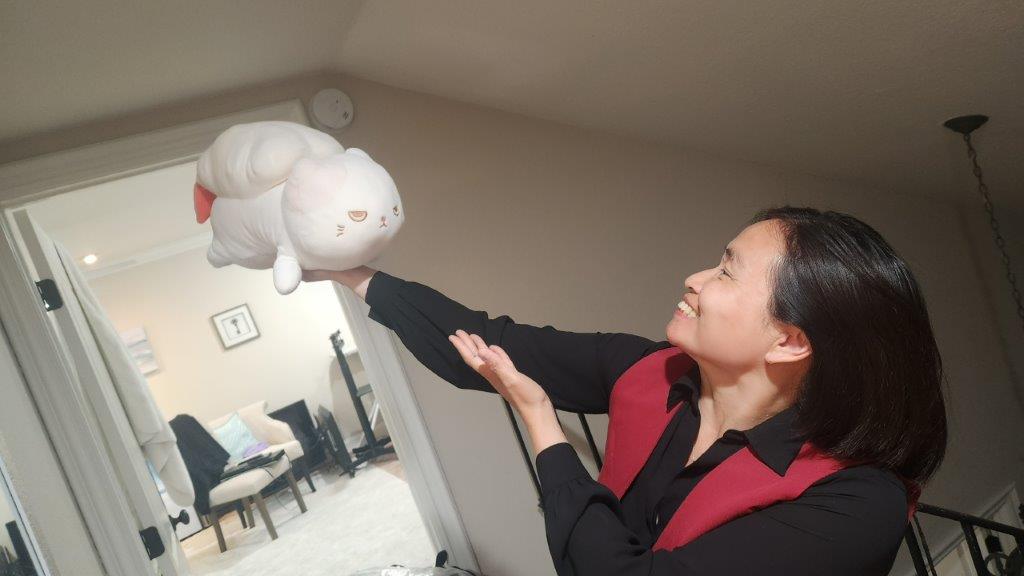
On April 15, 2025, I walked into the classroom in Santa Ana for my first class at 7:00 PM, and as I anticipated, I found myself surrounded by seven young, enthusiastic kids, their energy filling the room. The teacher kicked things off with a warm-up called “claps transfer,” where we passed claps around the circle to foster focus and connection—it was a simple but effective way to break the ice. Next, the teacher scattered papers across the floor, each one labeled with a written objective for acting, such as “to be loved,” “to be respected,” or “to destroy.” We were instructed to pick one, reflect on its story, and perform it for the others to guess the objective behind our acting.
I selected a paper, but I felt completely lost—I had no clue how to bring the objective to life through acting. Despite my uncertainty, I gave it my all, and to my delight, one of the kids correctly guessed what my performance was meant to convey. That small victory filled me with joy and boosted my confidence, encouraging me to team up with a partner for the next activity. I focused intently on understanding the objective and stepping into the role, though I couldn’t shake the worry that I might disappoint my partner. We rehearsed together until the class wrapped up at 9:30 PM, and despite my initial nerves, I found the experience both fun and deeply enriching.
As a realtor, I’m no stranger to challenges, but this class stretched me in an entirely new way, pushing me far beyond my comfort zone. I’m already looking forward to my second class, excited to continue learning and growing through this incredible journey.
April 28th, 2nd Class
After a full day of showing properties to a buyer, I hurried home for a quick dinner of yogurt and an egg before rushing to my third acting class in Santa Ana on April 28 at 7:00 PM. The class was an absolute joy, filled with learning and emotional breakthroughs. I set my phone to airplane mode—a refreshing change that let me fully immerse at the moment, free from the constant pull of messages and WeChat notifications.
The teacher began by asking, “How was your reading?” I admitted, “I read it, but I found it boring.” To my surprise, the teacher responded, “That’s good. How will you turn a boring book into an interesting scene? That’s what actors do.” This set the tone for the night—transforming challenges into opportunities.
We started practicing a scene with the characters Katie and Brandon, set in a ghost town. Brandon, frightened by the eerie surroundings, enters a shop where Katie waits, and she must convince him to grab their things and leave together. However, Brandon refuses to leave despite Katie’s efforts. The teacher divided us into groups, and I had the chance to play Katie twice. In my first attempt, I gave in too quickly, prompting the teacher to pause and guide me. We redid the scene, and I improved, but we paused again for advice on understanding Katie’s objectives—to protect and persuade. On my third try, I froze when Brandon said, “No, I won’t go with you.” I didn’t know how to respond, feeling stuck. The teacher analyzed the scene, offering insights, and we practiced a fourth time, each attempt helping me grow.
My second practice was with a different Brandon, who struggled to stay in character, requiring several pauses for the teacher’s guidance. After that, we took a five-minute break. During the break, the younger students discussed the scene’s deeper meaning while I checked my phone for messages and emails, balancing my real estate responsibilities.
The second session began with a new exercise: “Don’t go.” The teacher asked for volunteers, and I immediately stood up and walk to the front, eager to participate despite not knowing what the exercise entailed. The task was to convince a partner not to leave, but the partner would leave regardless. We all took turns as the “talker” and “walker,” receiving feedback from the teacher. At one point, when the teacher instructed me to keep stopping my partner, I instinctively grabbed his arm. The teacher quickly intervened, saying, “No physical touch,” and I realized my mistake. We adjusted, and the teacher then asked us to imagine a loved one—family, parents, or friends—leaving for a dangerous situation where something terrible, even death, might happen. We could walk and talk to stop them.
I pictured my daughter in front of me, pleading with her, “Don’t go.” Tears welled up as I said it the first time. The teacher paused us, offering tips to deepen our performance, and we restarted. With tears in my eyes, I begged my partner, “Don’t go, don’t go, please don’t go,” crying as I spoke. I was amazed—I couldn’t believe I was crying, truly feeling the desperation to stop him. In that moment, I understood how actors cry in movies and felt the profound power of love between parents and children.
With five minutes left, the teacher summarized the class, emphasizing the importance of immersing ourselves in real emotions to bring scenes to life. I left feeling inspired, having learned that putting yourself in a real emotional environment can lead to powerful performances.
3rd Class
I recently attended my first Caroline’s “Living Truthfully” acting class, and it was a transformative experience that deepened my appreciation for genuine expression. The class began with the teacher calling our names and asking each of us why we chose to enroll. I was taken aback when she mentioned she knew I was a “phone student” because my previous teacher, Adam, had shared this with her—along with the fact that I was delighted to be in the class. My first thought was, “What? They talked about me?” I had been using my phone earlier because the teacher’s discussion felt unrelated to us as new students, leaving me disconnected. I also noticed Adam frequently glancing at his watch during lessons, which added to my sense of being out of touch.
After this opening exchange, we explored the first chapter of The Seven Pillars book, delving into the concept of “contact.” We paired up for an exercise, gazing into each other’s eyes to uncover the authentic emotions that emerged in that moment of connection. The teacher then distributed scripts but asked us to refrain from reading them aloud right away. Instead, we worked in pairs as Partner A and Partner B. Watching the first group perform gave me valuable insights, and I felt inspired to volunteer as the second pair to take the stage.
During the exercise, Partner A read their script to Partner B, who responded based on the questions asked, and then we switched roles, reading the Partner B script with what the teacher described as a “dripping over” effect. I took a unique approach, repeating lines a few times, which led the teacher to offer constructive feedback. Wanting to understand better, I asked, “Do you mean the ‘dripping over’ should reflect the same tone as the script’s impulse response?” She confirmed, explaining that “living truthfully” means honestly expressing what you think and feel, then bringing that sincerity into your acting.
This class not only ignited my excitement for continuing this journey of truthful expression but also taught me a broader life my excitement for continuing this journey of truthful expression but also taught me a broader life lesson. As a realtor I’m learning to set boundaries with my phone—at least for the 2.5 hours of class. In the past, I often prioritized work over family, even responding to emails during dinners with loved ones, admitting I placed my job above them far too often. Acting class is teaching me the art of compartmentalization, helping me balance my professional and personal life more effectively.
4th Class
I attended my fourth acting class in Santa Ana on May 5, 2025, and it was a truly rewarding experience. The teacher started by delving into the objectives of the scene and each script, helping us forge a deeper connection with our characters. I found myself stepping out of my comfort zone, bravely sharing whatever thoughts came to mind and engaging actively with the teacher. I’m so proud of my progress in embracing vulnerability and opening up.
We were given a piece of paper and asked to fold it in half. On one side, I wrote my name, Joan League, and on the other, my character’s name, Katie. The task was to write emotion statements in the format “I would be… if…” For myself, I wrote: “I would be scared if someone held a gun to my head,” “I would be successful if I saved a child drowning in a river,” and at the top, “I would be happy if I became an actress after these 10 weeks of classes.” I then mirrored the exercise for Katie, capturing her emotional perspective. Next, the teacher gave us 4 minutes to craft a story that brought these emotions to life. I froze—my mind went completely blank, unsure of how to proceed. I approached the teacher and asked, “Do I need to create a story to express the emotion?” She responded gently, “Go back and immerse yourself in the scene.” Despite her advice, I still felt stuck, overwhelmed as I listened to the younger students around me performing with such passion. When the 4 minutes ended, the teacher asked us to grade ourselves. I gave myself a 1 out of 10, while some of the kids rated themselves between 5 and 9.
Determined to grow, I shifted my approach, blending my real-life experiences as a realtor into the exercise. I chose “stress” as my emotion, reflecting the pressures of my work, and this time, I felt much more confident in my performance. Following this exercise, we returned to the Katie and Brandon scene from the previous week. Our familiarity with the script had grown, and we all showed noticeable improvement. In the scene, Katie urges Brandon to leave their current place for a brighter future, but Brandon, despite his earlier promise, refuses to leave. This time, I fully immersed myself in the role, spontaneously adding the line “Fuck New Orleans” to convey Katie’s deep frustration. The line struck a chord, earning applause from the class. I paused twice—briefly thrown off by the audience’s laughter and my own—but I felt a stronger connection to the scene than ever before.
The second Brandon in our two performances had significantly deviated from the script, adding extra words and taking a winding path to tell Katie he wouldn’t leave. The teacher intervened, reminding us to adhere to the script’s boundaries, but the student, a bit headstrong, engaged in a short debate with her. Shortly after the teacher’s feedback, our time was up, and the class concluded. As a realtor in Northwood Estates, I’m discovering how acting helps me channel emotions like stress and determination, skills that enhance both my performances on stage and my dedication to my clients. I’m looking forward to next week’s class with renewed excitement!
5th Class
Today, I attended my fifth acting class. The teacher began by asking which students had done additional acting work and what we had watched. My mind was preoccupied with real estate, and after watching a movie, I struggled to recall details. I apologized, wanting to be honest. Other students shared about shows they’d watched, but I had no clue what they were talking about. I don’t have time to watch shows, and we don’t have cable at home. More importantly, if I start watching a show, I can’t stop—I could stay up 24 hours straight. To avoid distractions from my real estate business, which is demanding, I choose not to start.
The teacher then transitioned to the new lesson on actions. He engaged the students with some figurative words. When it was my turn, I admitted, “Sorry, I can’t.” Next, the teacher gave each student a verb we weren’t allowed to see. He provided a sentence, and we had to say it first in a plain tone, then look at our verb and express the same sentence to convey the verb through our delivery, letting others guess it. My verb was “reverse,” and my sentence was “I am fine.” The teacher said I did well, which felt encouraging!
After that, we wrote down a transitive verb. I chose “push.” We were given a piece of paper with several sentences, and each student had to pick one, go on stage, and perform it using their action word. I performed “What is the matter?” to convey “push.”
Later, we returned to a scene we had practiced before. The teacher asked us to write a verb for each line of our character’s dialogue. After finishing, we rehearsed with our partners and then performed on stage. I’m not sure how I did—the teacher didn’t comment—but I know the other students performed really well. I enjoyed the class and feel like I’m learning something new every day.
Class 6
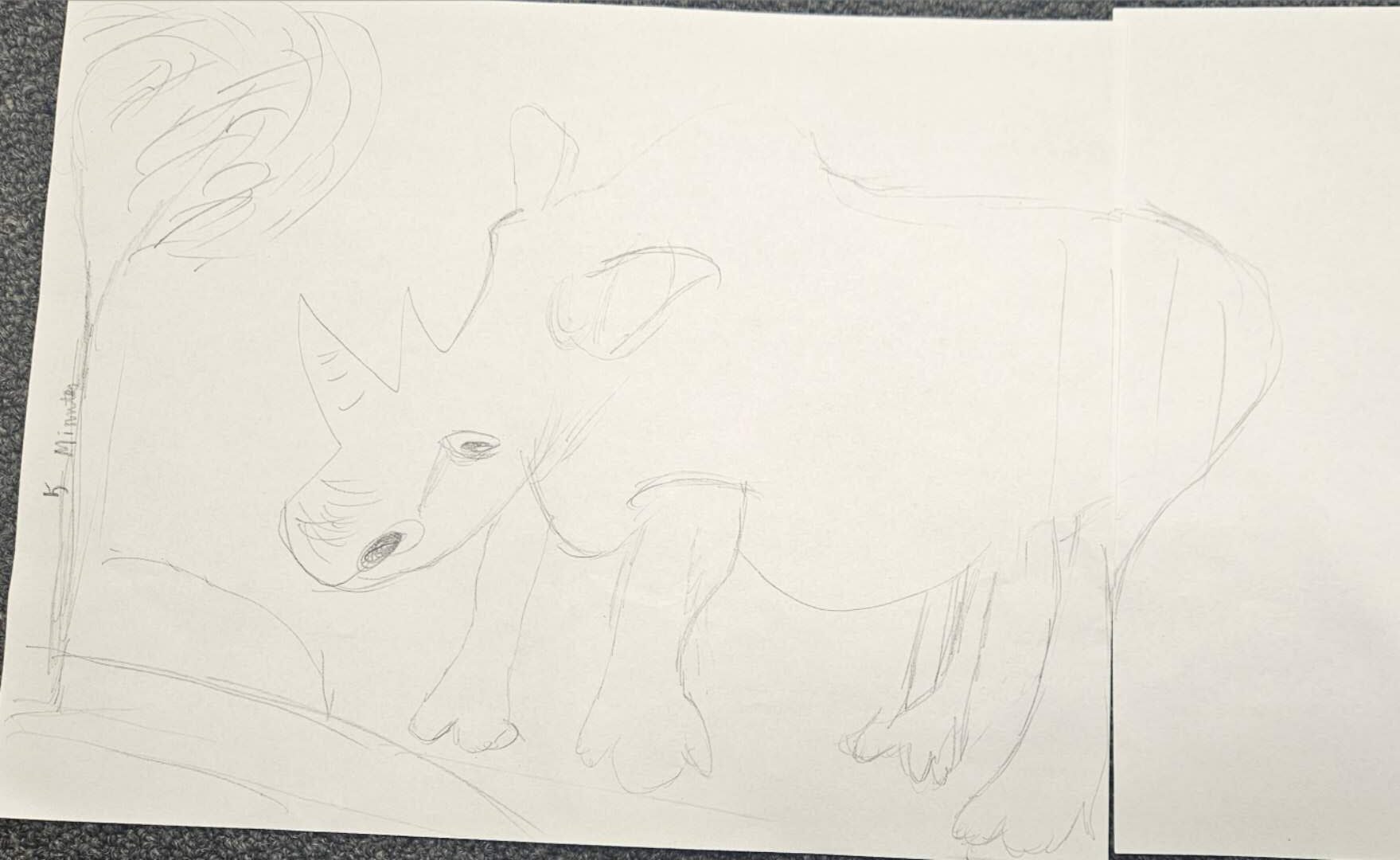
Today, the teacher instructed us to draw a rhino on paper. Struggling to see clearly, I scooted my chair closer. My rhino turned out too big for one sheet, so I used a second page for its rear. Soon, we were told to lay our drawings on the floor. I pointed out one as the best, but the others booed me. I thought I was being honest, but it’s not about good or bad—participation matters most. Then Adam, our teacher, had us use the eraser end of the pencil to mimic drawing and note the differences. I just went for it.
Afterward, Adam called for a break and shared a story from two years ago at a Scientology workshop. Having moved from Ohio to LA, he attended a Cathy Smith workshop, only to realize it was more about draining your spirit than just your wallet. The sessions ran from 10 a.m. to 2 p.m., were a complete waste of time, and he couldn’t wait to leave. Next, we moved on to learning monologues. Adam gave us a paragraph to read, analyze the objective and action in each sentence, and practice in pairs. I teamed up with Jake. Watching the first three groups perform taught me more—there’s no good or bad, just do it. I performed, unsure of the result, but who cares? Just do it.
Class 7
Today’s “Living Truthfully” acting class was eventful. I couldn’t find the script, and the teacher subtly implied it was a shame. Oh well, I am who I am. During the discussion, the teacher asked what shows we’d watched. I watched Shogun with Sean but didn’t mention it in class. I was exhausted and only finished one episode before bed. This week, I’ve been sleeping early to get more rest. I looked online about the show the teacher mentioned and realized I’m too old for soap operas and don’t have time to finish them. I’ll catch a movie when I can.
We started with intense warm-up stretches. Thankfully, my morning Pilates helped me keep up. After warming up, we paired into A and B teams. We did a movement exercise with a “negative” twist: A led B, mirroring every step, creating shapes through movement. Then B led A. We were encouraged to stretch high, go low, and explore creatively. My partner, a young, handsome guy, and I did great, though sometimes I forgot to lead him. He reminded me, and the teacher had us perform for the class. The movement was a huge effort; my leg muscles felt tight, and I was exhausted.
Next, the teacher had each pair perform. With eyes closed, we held hands; A led B, then B led A, following the teacher’s rhythm. Then, with half-open eyes, we created shapes, sat on chairs, and continued moving while stretching our spines. We grabbed scripts from under the chairs, kept moving, opened our eyes, and read the lines while maintaining eye contact with our partner. We even walked around while reading. At first, I wondered how these exercises tied to acting, but I realized these movements help blend body movement, contact with a partner, and script delivery. It was fun, though my legs will be sore tomorrow. Taking this class feels refreshing—no phone, no real estate stress, just presence.
Today marked the fifth “Living Truthfully” class, where we discussed White Lotus. Sean grabbed the DVD since we lack cable TV. The show’s chaotic plot isn’t my favorite, but it was last week’s homework. I powered through Season 1, a six-hour commitment. Our vibrant teacher, who’s always singing and dancing, kicked things off with warm-up exercises. One involved squatting against the wall, hips aligned with knees. I tried but couldn’t hold it long.
We then dove into a “Daydreaming” exercise about past experiences and continued with the Count on Me script. The teacher wanted us to read it all, but I managed only 20 pages. I’m Sammy, whose brother, Terry, is the other lead. Orphaned young, they’ve faced hardships. Terry’s life spiraled, landing him in jail for three months. Six months ago, he sent Sammy a postcard from a Florida jail, unbeknownst to her. Now, he’s back to reconnect. We explored their roles and exchanged thoughts.
Next, we spent five minutes reflecting on our morning routines. Then we walked around, which felt endless. I thought I was done, but others kept going as the teacher counted down. In another five-minute exercise, we verbalized our morning activities in detail. Thirty seconds before class wrapped, I ran out of words, so I sat and pretended to type on a computer.
Class 8
I was seven minutes late for class because the seller delayed handing over the keys to the buyer. We hurried home, dropped off Sean, and grabbed some nuts to eat while driving. The trip took about 20 minutes without traffic. I felt guilty for being late, as I’m punctual 99% of the time, but occasional delays happen. Honestly, there’s no excuse for being late to appointments if you respect others. I slipped into class quietly as it began. I noticed three new faces, while three of them who were with us were absent. The teacher was explaining “Action,” and the newcomers seemed like new students. Since we’d already had seven classes, I wondered how they’d join us. I forgot my script and borrowed a copy from the teacher, promising to bring mine next week. The teacher had us practice a scene with Katie and Brandon, crafting an opposite response to Katie’s line: “This is the only chance to slip, we are dead if they catch us.” I wrote: “Let’s die together if you want me to die.” Last Monday was Memorial Day, so we had no class, and the week before, we didn’t rehearse the scene. After two weeks without practice, my progress felt lost—I performed like a beginner. I had to repeat my lines several times before the teacher let me leave the stage. We then rehearsed by swapping roles, reinforcing that practice makes perfect. One girl impressed me by memorizing the entire script flawlessly.
Class 9
We later tackled a “Yes, and…” improv game, with Partners A and B riffing off each other. Then we chose a scene where Terry, Sammy, and Rudy (Sammy’s son) enjoy park time as a family. We nailed it and shared high-fives. Finally, we rehearsed Terry and Sammy’s scenes from Count on Me. I learned acting from someone else’s script is tougher than using my own material. Still, it was a blast of a class!
Class 10
In our “living truthfully” acting class, Clay and I arrived 30 minutes early to rehearse our scene. With the classroom locked, Clay suggested practicing outside. We felt good running the scene without scripts, even improvising a continuation of episode 3. Our teacher, Caroline, arrived and let us use her office to keep practicing. At 6:58 PM, we entered the classroom.
Caroline began by checking in on everyone’s week. Most seemed happy, but I didn’t share my chaotic real estate week—an offer almost rejected to counter by the seller for being a lowball, a full-price counter after long time talking, and an unethical listing side talking to my buyer directly. Instead, I mentioned watching Yellowstone and noting that running a ranch, with its politics and dangers, seems harder than real estate.
Caroline then introduced the “7 Pillars” from the assigned book. Since most of us might not read it, we struggled to differentiate “circumstance” from “meaning.” Caroline used an example: if you learned your home had cockroaches during class, what would you do? I wrote I’d buy pesticide at Home Depot and handle it. She asked what a partner might do, explaining that “meaning” is how we respond to random circumstances.
Next, we picked two scripts to analyze for circumstances and meanings. I went first, selecting the line: “I’m glad to see you too, Sammy. Um… Are you coming from work?” I said the circumstance was the character’s confusion at his sister’s formal attire, and the meaning was his surprise to see his sister’s formal dress. Caroline corrected me: the circumstance was him not knowing it was Saturday (thinking it’s a weekday), and the meaning was his need to realize the correct day. We each shared our scripts in class, and Caroline patiently clarified each one.
We practiced our scenes with and without scripts, applying these concepts, though I wasn’t sure I improved. Caroline then explained the “Bomb list,” (It’s is something shocking to the characters) highlighting key script moments—like Sammy asking Jerry, “What did you do?” after learning he went to jail. She described a “Bomb” as an isolated circumstance where we must identify the meaning, express our feelings, and reflect personally. The theoretical discussion overwhelmed me, like I was floating in space. When tasked with creating three “Bombs” from the script, I felt mentally drained.
We ended with jokes to lighten the mood, as everyone was tired. I grasped that the class aimed to make us act more truthfully through understanding circumstances and meanings, but it’ll take time. I asked Caroline about her other classes, like her clear, well-prepared teaching style.
Caroline mentioned she’s teaching a Movement class. Curious, I asked what it involves. She explained it includes 30 minutes of movement per session. I said I’m fine with that, as long as there’s no homework or reading assignments, since I find the book dull. Everyone was laughing about my no homework. I am really busy, so better no homework: )
In today’s acting class, the teacher asked about our professions and how we excel in them. We shared that we learned from a mentor and were trained by a broker. With only four students present—unsure where the others were—we dove into comedy. The teacher asked what helps us shine in comedy. I quickly said “sense of humor,” then added “pun,” but drew a blank after that. The teacher jotted our responses on the whiteboard, using colorful chalk to emphasize “sense of humor,” which made me smile.
Class 11
We got a script and paired up as A and B. I played Anna, while my partner took on Harold, a boyfriend “rented” as a gift from Anna’s friend, Valerie. We watched another pair perform, noticing their male portrayal of Anna, which contrasted with my female interpretation. Andrew and I rehearsed in the hallway, tossing around ideas to punch up the humor. After ten minutes, we observed another group’s performance, taking notes. The teacher urged us to learn from them but adapt their techniques to fit our own styles. It was so much fun!
Class 12
Today, I skipped the 3 hours Weird AI Yankovic show to attend Carolina’s acting class, even though Sean had bought two tickets. The class was delayed by two weeks, forcing me to choose between the show and the class—I chose the class. Before starting, Carolina had us share updates from the past week. Then, she asked us to walk back and forth in the room, portraying our life from birth to now, reflecting on happy and sad moments. I joked that I needed more time since my life was longer than other students’. I traced my life: my birth (as my mom described), being disciplined by my mom for poor test scores, witnessing my mom’s suicide attempt with pesticide at age eight, attending boarding school (where I kept an English diary), high school (trying to transfer to a better school in my final semester, but my teacher blocked it to keep a strong student—my dad intervened), college (tutoring English for an attorney’s family and saving money), working as an interpreter, getting married, having a daughter, getting divorced, becoming a tour guide, starting a tutoring business, losing my mom, meeting my current husband, and landing my current job. I told the class, “I could write a book about my life.”
Carolina then asked us to pick three key memories and walk while reflecting on them. I chose my mom’s pesticide incident (sad), my daughter’s college graduation (happy), and a fight with my manager as a new real estate agent. Next, we paired up as A and B—I was B. We shared exciting stories. My partner (A) recounted being 12, traveling with his uncle, and being told to take the subway alone to find their hotel without a phone. After getting off, he got lost, asked a cop for help (who ignored him), and faced people telling his friend not to talk to him (a White boy). Anxious and scared, he wandered until he found the hotel. I shared my evasive driving class from last year in two minutes. We then had one minute to ask each other questions, followed by 30 seconds for more.
Next, we crafted a monologue based on our partner’s story. After a break, we created a scene inspired by our monologue, summarized in one sentence. I went second, using my partner’s story of being scared while lost. I created a scene about taking helicopter lessons, failing twice while others laughed. Carolina asked me to make it real, so I shared my actual helicopter lesson experience, showing how terrified I was during takeoff and landing. The class applauded, and when I tried to sit, Carolina made me stand for more claps—we felt like kids needing encouragement. Everyone presented their scenes, and Carolina offered feedback. It was a fun class.
The Final Class
Today was the final session of my acting class, a cherished birthday gift. Carolina prompted us to share our “rose and thorn” for the week. Our teacher shared her thorn: her car broke down three times. My rose was opening an escrow, but my thorn was a community movie night that went wrong. We planned to screen Jurassic Park, but a neighbor reported us to the movie company. Luckily, we canceled, avoiding trouble. We then reviewed our “bomb list.” I stayed silent until everyone shared. When the teacher asked, “Who’s next?” I said, “Me,” and we all laughed, including me. Others’ bomb lists seemed unrelated to the script, but before I could ask, the teacher asked, “Did you do the homework?” I said, “Yes,” confidently, but when she asked again, I repeated, “Yes,” feeling uneasy. She asked about the circumstances, and I said, “Sammy didn’t mind her brother showing up yesterday.” She clarified, “You’re acting as Sammy, so why talk about Sammy? We need Terry’s perspective. The circumstance is: He didn’t show up yesterday. That means he doesn’t care about the meeting.” She added, “Terry didn’t show up after two years of no contact. How do you feel?” I replied, “Hurt.” She nodded, saying, “Some people thrive under pressure.” I chuckled. We wrote an emotion prompt: “I would feel… if…” I wrote mine but kept it private. The teacher performed a scene blending personal experience, moving me to tears. When it was our turn, I admitted combining personal experience with the scene felt tough and asked to use the bathroom. She said, “Wrong time,” but I went, brainstorming ideas. Back in class, I saw others practicing and joined in. It went surprisingly well. We later reflected on circumstances, meaning, and emotions before performing. I planned to rehearse with my partner at 6:15 PM but arrived at 6:30 PM after showing a property. We practiced until 6:55 PM and were the third pair to perform. I forgot a line but felt great despite the pressure. It was our best run. The teacher gave one-on-one feedback. I admired her passion, energy, and textbook-aligned lessons. While she met with the first student, we chatted loudly in the hallway. My “tiger mom” nickname amused me, as we were all adults, aged 22 to over 30. I could’ve prepared more if I were a full-time student. She suggested improv, scene study, and voice classes. We exchanged numbers, planning a reunion. I stayed until 10:30 PM, with one student still waiting to talk to the teacher. The class was fun, unifying, and enriching. I’m amazed I finished and already miss everyone.
Enjoyed Joan’s story?
When you’re ready to talk Orange County real estate — buying, selling, or a bilingual consult — we’re here. Explore more on our Watch hub.
You must be logged in to post a comment.